Method Definition Schematic
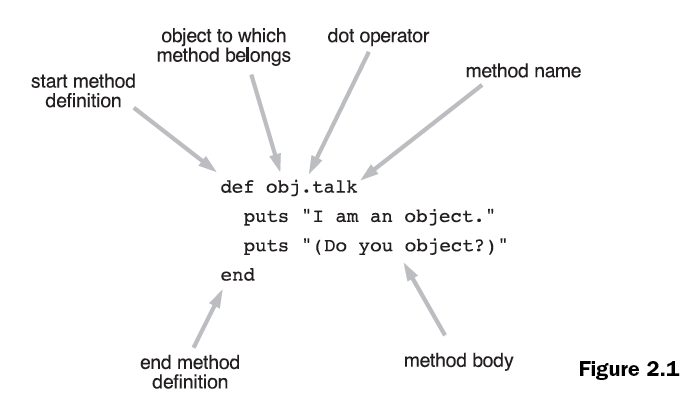
Ref. The Well-Grounded Rubyist PDF, Fig. 2.1
This section introduces Ruby's object-oriented programming model, including instances, methods, parameters, and memory management (instances and references). Later sections cover classes and modules and further topics.
Ref: WGR Chapter 2. Objects, methods, and local variables
Note: Following WGR's lead, in this section we define methods on instances (not on classes), to keep the lessons simple.
An object encapsulates state and behavior.
One way to think about objects:
Objects are things that can be described and can do things, or...
cookie = Object.new
cookie refers to an object instance
fruit = "apple"
"apple" is a string literal
fruit now refers to a new object instance
| Stack | Heap | |
|---|---|---|
| fruit | -> | "apple" |
fruit = "apple"
dessert = "apple"
fruit refers to a new object instance
dessert refers to a different, new object instance| Stack | Heap | |
|---|---|---|
| fruit | -> | "apple" |
| dessert | -> | "apple" |
fruit = "apple"
dessert = fruit
fruit = "banana"
dessert = fruit
What are the values of fruit and dessert after each line?
How can you tell if two references point to the same instance?
fruit = "apple"
dessert = "apple"
>> fruit.object_id
=> 2165091560
>> dessert.object_id
=> 2165084200
Ref. WGR Ch.2, Section 2.3.1
== params are equal (overridable).eql? params are equal and the same type.equal? params are identical (same object_id)== is usually what you wantNote that .equal? is not guaranteed since bizarrely, some objects override .equal? to do something else. If you really want to know if two variables reference the same instance, compare their object_ids.
fruit = "apple"
fruit = "banana"
friend = "Alice"
teacher = friend
friend.upcase!
teacher
=> "ALICE"
cookie = Object.new

def cookie.bake
  puts "the oven is nice and warm"
end
def cookie. ("def cookie dot") means "define a method on cookie"Behavior comes from messages and methods.
cookie.bake
prints I'm a cookie to the console
cookie receives the message bake and executes the method bake
.) is the message operator
Ref. The Well-Grounded Rubyist PDF, Fig. 2.1
methods method>> cookie.methods
=> [:nil?, :===, :=~, :!~, :eql?, ...]
>> cookie.methods(false)
=> [:bake]
also useful: cookie.methods.sort, cookie.methods.grep(/age/)
>> cookie = Object.new
=> #<Object:0x007f86e485c3a8>
>> cookie.methods(false)
=> []
>> def cookie.bake; puts "hi"; end
=> nil
>> cookie.methods(false)
=> [:bake]

>> "goo".methods.grep(/sub/)
=> [:sub, :gsub, :sub!, :gsub!]
respond_to? methodif cookie.respond_to? :bake
cookie.bake
else
puts "cookie is unbakable"
end
Note: Usually you don't use respond_to because of duck typing.
    def cookie.add_chips(num_chips)
      @chips = num_chips
    end

    def cookie.yummy?
      @chips > 100
    end

    cookie.add_chips(500)
    cookie.yummy?   #=> true
self is the default message receiver
self is set invisibly to always point to the current object
def cookie.yummy?
  @chips > 100
end

def cookie.add_chips(num_chips = 10)
  @chips
  @chips += num_chips
end

def cookie.yummify
  add_chips until yummy?
end
yummify the call to yummy? goes to self
/